
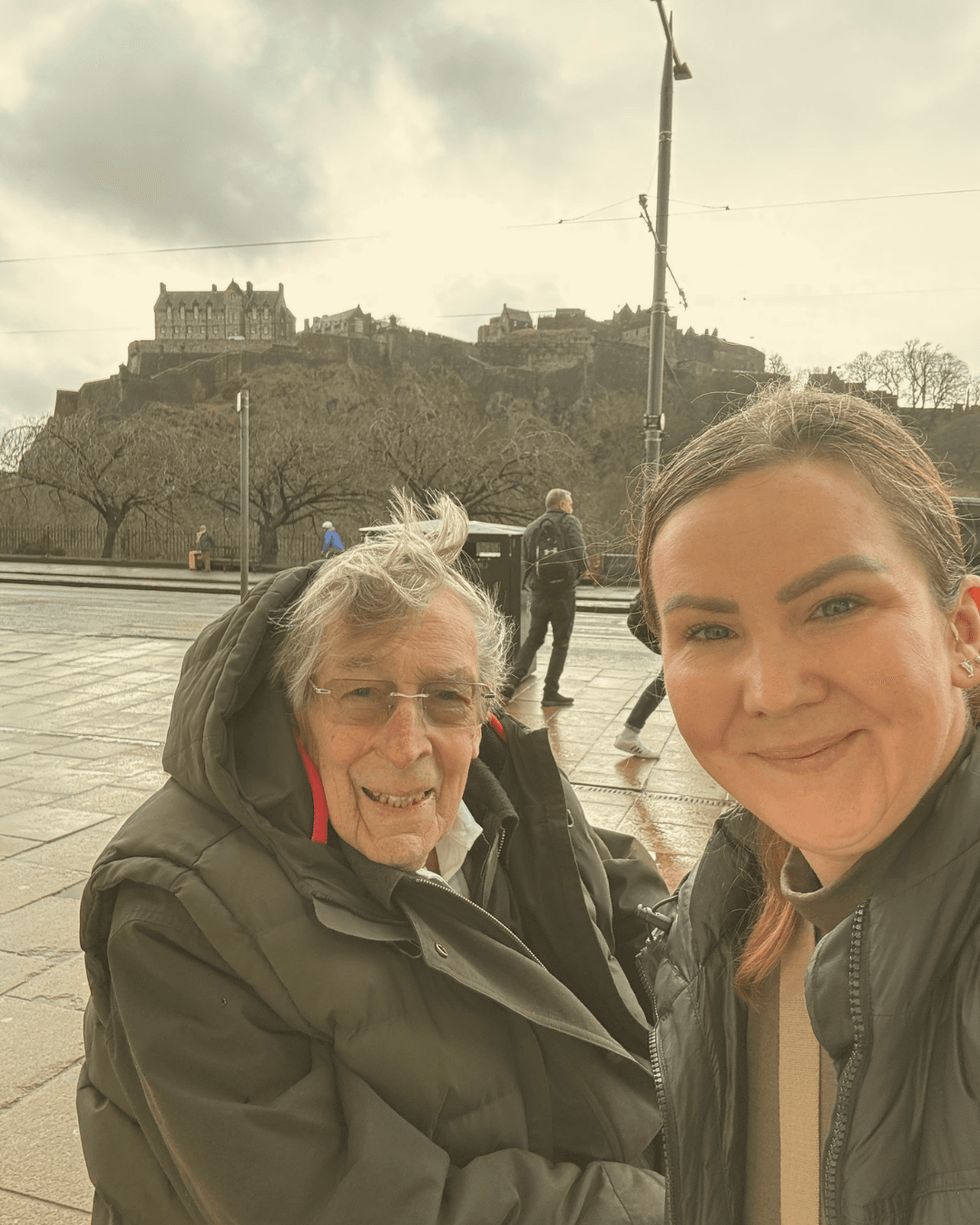
February has felt quietly expansive for me, not in the loud, milestone-heavy way that social media often celebrates, but in the deeply human way that stays with you long after the moment has passed. This month has been about movement, connection across generations, and navigating the tension between being a psychologist and being a human in very public spaces.
An Adventure Across the UK (With a 94-Year-Old Co‑Pilot)
One of the highlights of February was heading off on an adventure around the UK with my 94‑year‑old Popa. There is something profoundly grounding about travelling with someone who has lived through nearly a century of social change, resilience, and adaptation.
Our pace was slower. Our conversations were richer. There was less urgency to do and more space to notice. What struck me most was how curiosity doesn’t age out, if anything, it deepens. His questions weren’t about productivity or optimisation, but about people, places, and meaning. I definitely didn’t have all the answers and found myself doing quite a bit of searching, but in the process I also learned more about the Angel of the North and the history of the lochs.
In a culture that often sidelines older adults, this experience was a reminder that intergenerational time isn’t charity, it’s reciprocal. I gained perspective, humour, patience, and a kind of emotional anchoring that is difficult to replicate elsewhere.
Friendships That Span Decades
This theme continued when I met up with an 80‑year‑old friend I first met on a cruise. On paper, we shouldn’t have much in common. Different generations, different life stages, different reference points.
And yet, the connection works. We met in 2019 and have spoken on the phone pretty much every month since then. We navigated the pandemic together, love and, unfortunately, loss. I think that intergenerational friendships challenge the unspoken assumption that relationships must be age‑matched to be meaningful. They offer perspective without competition, wisdom without hierarchy, and connection without comparison.
Psychologically, these relationships matter. Research consistently shows that intergenerational connection can reduce loneliness, challenge ageist stereotypes (in both directions), and foster empathy. On a personal level, they also remind us that identity isn’t fixed, we are all constantly becoming.
What This Has to Do With Mental Health
As a psychologist, I’m increasingly aware of how age‑segregated modern life has become. We often talk about community, yet structure our lives in ways that separate generations almost entirely. Mental health doesn’t exist in a vacuum. It’s shaped by social connection, belonging, and the stories we tell ourselves about who matters and when. Intergenerational relationships disrupt the narrative that value diminishes with age, a narrative that quietly harms everyone.
Reflections From Running a Private Practice
Alongside these personal experiences, I’ve been sharing more openly on YouTube about the realities of running a private practice. Not the polished highlight reel but the complexity, uncertainty, and emotional labour that often goes unseen. Running a practice isn’t just about clinical skill. It’s about boundaries, finances, ethical decision‑making, burnout prevention, and identity. Many clinicians are quietly struggling with the gap between what training prepares us for and what private practice actually demands. These conversations matter because transparency reduces shame. When we talk honestly about the challenges, we create space for more sustainable careers and healthier practitioners. You can view some of my recent YouTube videos on this subject here.
The Difficulty of Talking About Politics as a Psychologist (and a Human)
One of the ongoing tensions I navigate, particularly on social media, is how (or whether) to discuss politics. As a psychologist, there is an expectation of neutrality, thoughtfulness, and ethical restraint. As a human, I exist within social systems that directly impact mental health, safety, and well-being. And all of that is live in the clients I work with and as I said above mental health doesn’t exist in a vacuum. Staying silent can feel complicit. Speaking up can feel professionally risky.
Social media collapses nuance. It rewards certainty over curiosity and outrage over reflection. For psychologists, this creates a double bind: we are asked to care deeply about social issues, while being judged harshly for expressing that care in public.
I don’t have neat answers here, only an ongoing commitment to reflexivity. To ask myself: Why am I speaking? Who might this help? Who might this harm? And to accept that discomfort is sometimes the cost of integrity.
Closing Thoughts
February has reminded me that meaningful connections often happen outside algorithms, outside echo chambers, and outside our own age brackets. Whether it’s travelling with a 94‑year‑old, maintaining friendships across decades, or having honest conversations about work and politics, a theme I see is courage but perhaps not in the typical image. It is courage to slow down. Courage to connect differently. Courage to be seen as complex.
And perhaps that, more than anything, is what conversations that matter really look like.
I didn’t mean that to be a segway but here we are, if you would like to join me on my youtube channel as part of my conversations that matter series you can find out more and apply here https://tr.ee/IH8tMJgdTI